Why Budgeting Is Freedom, Not a Cage
Nobody wakes up excited to make a budget. Nobody posts their monthly spending categories on Instagram. Nobody has ever described the moment they opened a spreadsheet and categorized their expenses as "life-changing."
And yet, if you ask anyone who has their financial life together what the turning point was, more often than not they'll tell you some version of the same story: "I finally sat down and looked at where my money was actually going."
That's what this is about. Not the sexiest topic in personal finance, not by a long shot. But it might be the most important one. Because you can know everything about index funds and compound interest, but if more money leaves your account each month than enters it, none of that knowledge matters.
The Real Reason People Avoid Budgeting
It's not laziness. It's fear.
Most people have a general sense that their spending is out of alignment. They know they're probably spending too much on dining out or subscriptions or things they don't really need. But as long as they don't look at the numbers, they can avoid the discomfort of confronting it. The budget is the mirror, and most of us would rather not look.
Here's what I wish more people understood: having a budget is not an admission of failure. It's the opposite. The most financially successful people I've encountered, people with seven-figure net worths, almost always know their numbers cold. They don't budget because they're struggling. They're not struggling because they budget. The causation runs in one direction, and it starts with the willingness to look.
What a Budget Actually Does
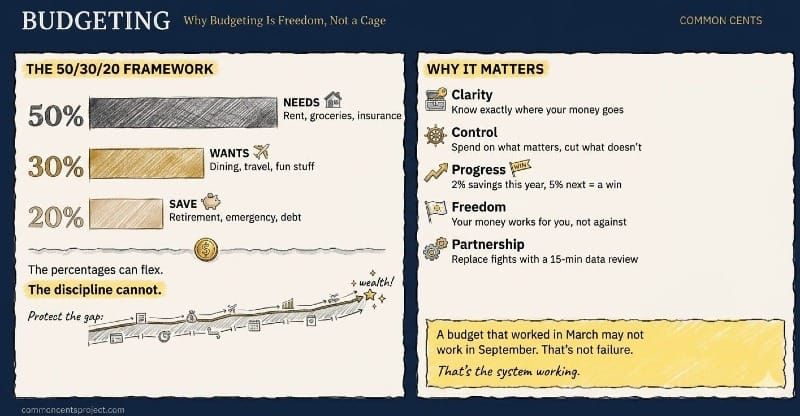
A budget shows you exactly where you stand. It eliminates the anxiety of not knowing. And it creates a baseline from which you can measure progress. If your savings rate is 2% this year and 5% next year, that's a win. Perfection is not the standard. Awareness and improvement are.
For some people, looking at the numbers will reveal that the problem is income. There's simply not enough coming in to cover the basics, and no amount of latte-cutting is going to fix that. That's a real and valid situation, and the budget helps you see it clearly so you can focus on the right solution: earning more, not just spending less.
For everyone else, the budget will likely reveal that the problem isn't income. It's allocation. You're making $75,000 and living like you make $78,000, and that $3,000 gap is the credit card balance that never quite gets paid off. The budget exposes this with uncomfortable clarity, and that discomfort is the first step toward change.
Budgeting Is Not About Cutting
Here's the part most budgeting advice gets wrong: it focuses entirely on what you should cut. Cut the lattes. Cut the restaurants. Cut the fun. That's a recipe for misery, not financial health.
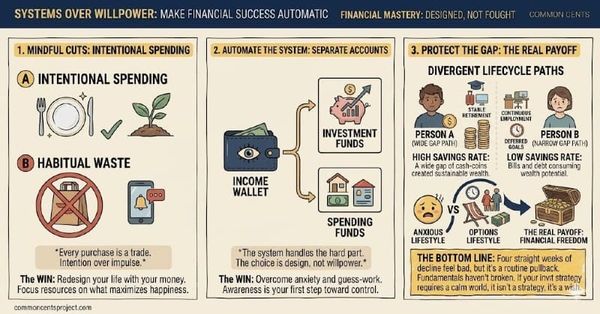
The better approach is conscious spending. Spend extravagantly on the things you genuinely love, and cut mercilessly on the things you don't. If travel is the thing that lights you up, your budget should be heavily weighted toward travel, and maybe you eat in most nights to make room for it. If you love great food, build that into your plan and drive an older car.
The budget isn't there to eliminate pleasure. It's there to make sure your pleasure is intentional, not accidental. Most people's spending is on autopilot. They spend roughly the same on everything and get mediocre satisfaction from all of it. A conscious spender directs resources toward maximum enjoyment and cuts the rest without guilt. That's not deprivation. That's design.
The Gap Is Where Wealth Lives
Over time, as your income grows, the most important thing you can do is grow your savings rate faster than your spending. Every raise is an opportunity to widen the gap between what you earn and what you spend. A $5,000 raise doesn't mean $5,000 more in spending. It means $2,500 more in spending and $2,500 more in investing. Protect the gap.
The people who build real wealth aren't the ones who earn the most. They're the ones who keep the widest gap between what they earn and what they spend. That gap is your savings rate, and it is the single most important number in your financial life. A person earning $80,000 who saves 25% will build more wealth than a person earning $200,000 who saves 5%. The math is unforgiving.
What Freedom Actually Looks Like
When your money is managed well, when you spend intentionally, save consistently, and invest wisely, you earn something no paycheck can give you: options.
The option to take the job you actually want instead of the one that pays the most. The option to be there for the school play instead of stuck at the office. The option to absorb life's curveballs and keep moving. The option to retire on your terms, not someone else's timeline.
That's what a budget buys you. Not restriction. Freedom.
It's the difference between your money controlling you and you controlling your money. It's the difference between "where did it all go?" and "I know exactly where it went, and I'm okay with it." It's the clarity that cuts through the shame and the guessing and the late-night anxiety.
Start by looking at where your money actually goes. That's it. That's the first step. Not a perfect spreadsheet, not a complicated app, not an overhaul of your entire lifestyle. Just look.
Everything else builds from there.