Weekly Review: March 23 - 27, 2026 | The Dow Joins the Correction, Oil Tops $110, and Big Tech Has Its "Big Tobacco" Moment
What Happened, What It Means, and What You Should Do About It
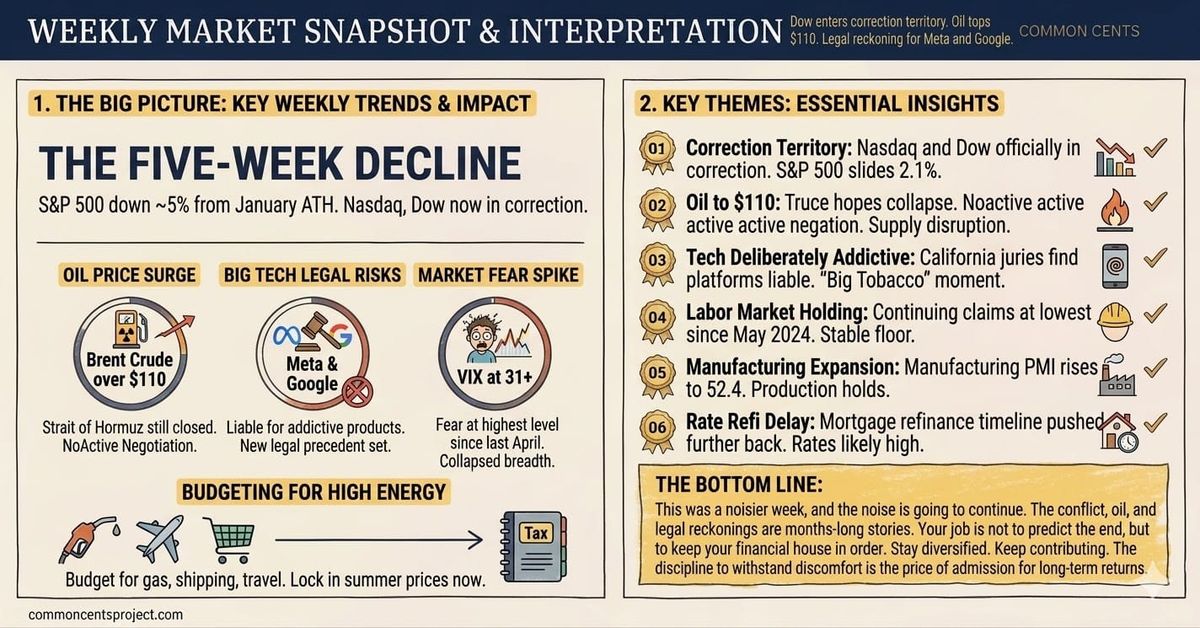
This was not a quiet week. The Dow fell into correction territory. Oil topped $110. A California jury told Meta and Google they are legally responsible for making their products addictive. And the S&P 500 posted its fifth straight weekly decline, something it hasn't done since 2022. If last week felt unstable, this week turned the volume up.
But here is the part that matters more than any headline: nothing about this week changes what a disciplined long-term investor should be doing. Let's walk through what happened and why.
Markets: Five Straight Weeks of Losses
The S&P 500 dropped 2.1% for the week, closing at 6,369. The Nasdaq slid 3.2% and is now officially in correction territory, down more than 13% from its October high. The Dow lost 0.9% for the week and fell below the correction threshold on Friday after a 793-point drop.
The pattern this week tells the story. Markets rallied early on Monday and Tuesday when President Trump described "very productive" talks between Washington and Tehran and announced a five-day pause on strikes against Iranian energy infrastructure. Stocks gave it all back on Thursday and Friday after Iran denied any active negotiations, rejected a formal ceasefire proposal, and Brent crude climbed back above $110.
The VIX (the market's fear gauge) closed at 31, its highest level since the tariff disruptions last April. Market breadth has collapsed. Less than 20% of S&P 500 stocks are trading above their 50-day moving average, down from over 70% in January.
What this means for you: Five straight down weeks is uncomfortable. But context matters. The S&P 500 is still up significantly from where it was two years ago. If you are investing in index funds on a regular schedule, you are now buying at lower prices than you were in January. That is how dollar-cost averaging is supposed to work. The worst thing you can do right now is stop contributing because the headlines are scary.
Oil: $110 and the Strait of Hormuz
Brent crude topped $110 on Friday and briefly touched $113, driven by the collapse of ceasefire optimism and renewed strikes on Iranian nuclear sites and steel facilities. West Texas Intermediate followed, and Macquarie analysts raised their oil price outlook for the year, citing the ongoing supply disruption in the Middle East.
The Strait of Hormuz remains closed. Roughly 20% of the world's oil supply moves through that waterway. President Trump extended his deadline for Iran to reopen the strait to April 6, but the market is pricing in the possibility that this drags on much longer. Energy stocks continued to outperform, with Exxon, Chevron, and Suncor all finishing the week higher while almost everything else fell.
What this means for you: Oil above $100 is a sustained inflation tax on consumers. Gas prices, airline tickets, shipping costs, and groceries are all affected. If you have been putting off reviewing your monthly budget, this is the nudge. Travel stocks took a hit this week too. Carnival cut its 2026 outlook, and Delta and United both fell. If you have travel booked for this summer, consider locking in prices where you can.
Big Tech's "Big Tobacco" Moment
On Tuesday, a New Mexico jury ordered Meta to pay $375 million in civil penalties for endangering children and misleading the public about platform safety. On Wednesday, a Los Angeles jury found both Meta and Google liable for designing platforms that addicted a young user, awarding $6 million in damages. The jury concluded that Instagram and YouTube were deliberately built to be addictive, that executives knew it, and that they failed to protect their youngest users.
Meta stock dropped nearly 4% on the week. Alphabet fell about 2.5%.
The dollar amounts are small relative to these companies' market caps. The precedent is not. There are more than 1,500 similar cases pending, plus lawsuits from over 250 school districts and multiple state attorneys general. Legal analysts are comparing this to the tobacco litigation of the 1990s that forced the industry to pay hundreds of billions in settlements.
Separately, Alphabet sparked a selloff in chip and memory stocks after unveiling a new AI algorithm that could significantly reduce the memory requirements for running artificial intelligence models. That is good news for the cost of AI long term but bad news in the short term for companies selling the hardware.
What this means for you: If you own a broad market index fund, you already own Meta and Alphabet, and you also own the 498 other companies in the S&P 500 that are not facing these specific legal risks. That is the point of diversification. For parents, these rulings are worth paying attention to regardless of your portfolio. The courts are beginning to hold platforms accountable for how they are designed, not just what content they host. That is a meaningful shift.
The Economy: Holding Together (For Now)
The economic data this week was mixed but not alarming. Initial jobless claims came in at 210,000, right in line with expectations. Continuing claims dropped to 1.82 million, the lowest since May 2024. The labor market remains stable.
Manufacturing showed improvement. The March manufacturing PMI rose to 52.4, up from 51.6, remaining in expansion territory. Services PMI slipped slightly but also stayed in expansion.
Consumer sentiment continued to decline, which was expected given oil prices and geopolitical anxiety. The final University of Michigan sentiment reading for March was revised lower.
Philadelphia Fed President Anna Paulson said elevated inflation is making her "more apprehensive about policy" and that she would feel more comfortable holding rates steady if inflation were closer to the 2% target. Some traders are now pricing in the possibility that the Fed could raise rates later in 2026, a scenario that seemed unthinkable a few months ago.
What this means for you: The job market is the most important indicator for your personal financial health. As long as people are employed and getting paid, the economy has a floor under it. But the longer oil stays elevated, the more pressure builds on consumer spending and corporate margins. Keep your emergency fund funded. If you do not have one, start building it now, even if it is $50 a week.
The Government Shutdown and TSA
A partial government shutdown continued this week, with TSA officers working without pay and airport delays increasing across the country. On Friday, President Trump signed an executive order to fund TSA paychecks, with officers expected to receive payment as early as Monday.
What this means for you: Government shutdowns are disruptive but historically short-lived. If you are a federal employee or contractor, make sure you have access to a buffer for delayed paychecks. This is exactly the kind of situation an emergency fund is designed for.
What to Watch Next Week
The big question is whether the April 6 deadline for Iran to reopen the Strait of Hormuz leads to any real progress or further escalation. Oil prices will move markets in whichever direction that answer goes.
On the data front, next week brings the Conference Board Consumer Confidence report, JOLTS job openings, ADP employment data, and the Chicago PMI. These will be among the first readings to capture the economic impact of the conflict.
The Bottom Line
This was one of the noisier weeks of the year, and the noise is going to continue. The conflict in Iran, oil prices, and the legal reckoning facing Big Tech are all stories that will play out over months, not days.
Your job is not to predict how those stories end. Your job is to make sure your financial house is in order while they play out. That means: keep contributing to your retirement accounts, keep your emergency fund accessible, revisit your budget if energy costs have changed your spending, and resist the urge to make portfolio changes based on a headline.
The market has been here before. It will be here again. The people who come out ahead are the ones who stayed disciplined when it felt uncomfortable.